

The Stasis Problem: Why Your Body Was Built to Move — and What Happens When It Doesn't
A unifying theory of disease, from kidney stones to clots to depression — and what eight weeks in a cervical collar taught me about the medicine of motion.

Welcome back to The Incredible Machine.
I’m Dr. Paul Manhas, MD — Dad x3, husband, and Co-founder of Manhas Health Co. Here, we explore the science of longevity, performance, and preventive health — and how small, consistent choices can transform your body’s “machine” for decades to come.
This is the issue I have wanted to write for years. The eight weeks I spent in a cervical collar finally gave me the space — and the personal evidence — to write it properly.
If you only read one issue of this newsletter, I would like it to be this one. The idea inside it is the single most useful lens I have for understanding why human beings get sick, and why getting better almost always involves the same answer.
Why Do People Get Sicker in Hospitals?
Early in medical school, when I first started spending real time on hospital wards, I noticed something that disturbed me.
Patients who were admitted to the hospital often got sicker over time.
Not all of them. Many got better, of course — that is the whole point of the institution. But a disturbing fraction of patients I followed would come in for one problem and develop two more during their stay. They would arrive with pneumonia and leave with a bedsore and a blood clot. They would come in for a heart attack and develop hospital-acquired pneumonia. They would be admitted for a hip fracture and acquire a urinary tract infection, then delirium, then a deep vein thrombosis.
I remember thinking, with the unfiltered clarity of a young trainee — isn’t the hospital supposed to be where people go to get better?
As I moved through residency, I started to see the institutional response to this problem hiding in plain sight. Every patient admitted to almost any ward in any hospital in North America gets a standard set of orders that we sign almost without thinking. They are called admission order sets. Look at what is on every one of them:
• Prophylactic blood thinners (usually a low-dose injection of heparin or enoxaparin), to prevent clots from forming in still legs.
• Sequential compression devices — inflatable sleeves on the calves that squeeze rhythmically to push blood back up toward the heart, mimicking the action of walking.
• Intravenous fluids running at a baseline rate to keep the kidneys flushed and the blood moving.
• Incentive spirometry — a plastic device patients breathe into to keep the bases of their lungs expanded so secretions cannot pool there.
• Pressure-relieving mattresses and turning schedules to redistribute load on the skin every two hours.
• Early mobilisation protocols — specific orders for nurses and physiotherapists to get the patient out of bed and walking as soon as it is safe.
Look at that list and ask yourself a question. What is every single one of those orders doing?
Every order on the standard hospital admission set exists for the same reason: to keep things moving in a body that has been forced to be still.
The hospital system, through painful accumulated experience, has worked out that lying in a bed is, in itself, a cause of disease. And so we attempt — chemically, mechanically, manually — to fake the motion that the body would normally generate on its own.
This was the first time I saw the pattern. Once I saw it, I could not unsee it.
A Word You Should Know
Before I go further, I want to introduce a word.
In medicine, we use a Latin-derived term to describe this phenomenon. The word is stasis. It comes from the Greek and Latin root meaning standing, or standing still — a state in which something that ought to be flowing has stopped.
Doctors use the word constantly, often without realising it. Venous stasis. Urinary stasis. Biliary stasis. Gastric stasis. Each of those phrases names a specific situation in which a particular fluid in a particular part of the body is not moving the way it should — and each of those situations is the proximate cause of a specific disease.
Stasis is, in my view, one of the most underappreciated unifying concepts in clinical medicine. Hold the word in your mind for the next ten minutes.
A Pattern I Could Not Unsee
As I moved through training, I started to notice something even more striking than the hospital pattern.
The diseases I was being asked to treat in the outpatient world looked, at first glance, like completely different problems.
A kidney stone. A blood clot in the leg. A stroke from atrial fibrillation. Pneumonia behind a mucous plug. Bedsores. Constipation. Lymphedema.
But the more cases I saw, the more I realised these were not separate problems at all. They were the same problem wearing different clothes.
Every one of those conditions starts with the same root cause: something that was supposed to be moving has stopped moving.
This is the lens I want to give you today. Once you see it, you cannot unsee it. And once you cannot unsee it, the question of why movement matters stops being abstract advice from your doctor and starts being the most obvious thing in the world.
I call it the stasis problem.
How Stasis Causes Disease
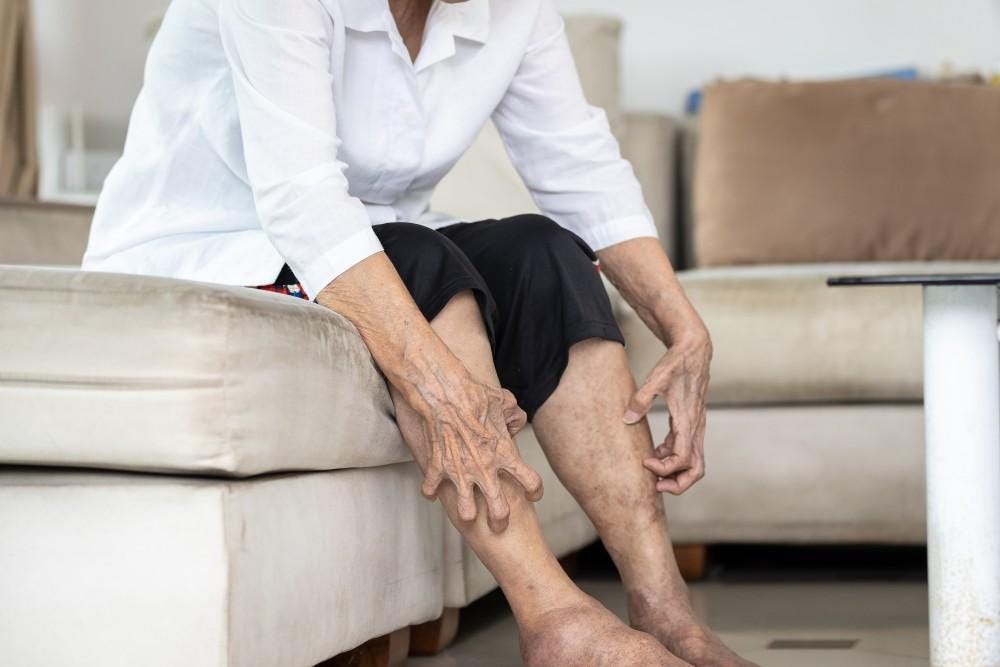
Your body is, at its core, a system of flowing rivers. Blood through arteries and veins. Lymph through lymphatic channels. Urine through kidneys and ureters. Bile through ducts. Mucus along airways. Air in and out of alveoli. Stool through the colon. Joint fluid across cartilage. Even cerebrospinal fluid pulsing around your brain.
Every one of those rivers is designed to keep moving. And every one of them, when it slows down, causes a predictable disease.
Let me walk you through what I mean. This is going to feel almost embarrassingly simple once you see it.
• Kidney stones. Low urine flow gives minerals time to crystallise. Solution: more water, more flow.
• Deep vein thrombosis. A blood clot in the deep veins of the leg. The biggest risk factor is prolonged immobility. Textbook Virchow’s triad — venous stasis is one of its three pillars.
• Atrial fibrillation and stroke. The atrium quivers instead of contracting. Blood pools in the left atrial appendage. A few seconds of stasis is enough for a clot to form, travel to the brain, and cause a stroke.
• Pneumonia. A mucous plug blocks airflow. Alveoli collapse behind it. Bacteria multiply in the warm stagnant pool.
• Pressure injuries (bedsores). Skin dies when blood flow to one point is cut off for too long by external pressure. Move the patient, the skin survives.
• Constipation and diverticular disease. Stool that sits too long becomes dehydrated and difficult to pass.
• Joint stiffness and osteoarthritis. Cartilage has no blood supply. It is fed entirely by joint motion. A joint that does not move does not feed itself.
I could keep going. Lymphedema. Frozen shoulder. Insulin resistance. Even certain forms of cognitive decline have been linked to stagnant cerebrospinal fluid clearance.
Not every disease is caused by stasis — autoimmune disease, genetic disease, and infections have other primary drivers. But an astonishing fraction of the chronic, preventable, daily medicine that fills our hospitals comes back to one question:
Is something that should be moving, moving?
A Machine Built for Motion
Step back and look at the design. The human body is a thing optimised for movement at every level.
Your circulation does not have one pump. It has many. Your heart drives blood out of the arteries, yes — but the return trip, blood coming back up against gravity from your feet to your heart, depends almost entirely on what is called the muscle pump. Every time your calf contracts when you walk, it squeezes the deep veins of your leg and pushes blood upward. The veins have one-way valves to prevent backflow. Walking is, quite literally, your second heart.
Your lymphatic system has no pump at all. It depends entirely on muscle contraction, breathing, and movement to clear fluid and immune cells from your tissues. When you stop moving, your lymph stops clearing.
Your lungs do not just sit there. The same diaphragm that pulls air into your chest also pulls venous blood up from your abdomen, and pushes lymph upward into the thoracic duct. Every deep breath you take is a circulation event.
Your cartilage feeds itself by joint motion. Your bones remodel themselves in response to mechanical load. Your brain produces a chemical called BDNF — brain-derived neurotrophic factor — in direct response to physical activity. Your muscles release dozens of signalling molecules called myokines every time they contract, which travel through the bloodstream and modulate immune function, mood, inflammation, and metabolism across your entire body.
This is not a machine that does well sitting still. This is a machine that begins to break down the moment it stops moving.
What Movement Actually Does to the Machine

Let me get specific about what happens, biologically, when you move. This is where the evidence is the strongest, and where the picture becomes almost unbelievable.
The Heart Becomes a Better Pump
With regular cardiovascular exercise, the left ventricle of your heart enlarges slightly and contracts more forcefully. Stroke volume — the amount of blood pumped per beat — goes up. Resting heart rate goes down because the same amount of blood per minute now requires fewer beats. A fitter heart at rest is doing less work per day to keep you alive.
This is not a small effect. Resting heart rate is one of the strongest non-invasive predictors of cardiovascular mortality we have, with multiple large cohort studies showing a stepwise increase in mortality risk for every ten-beat-per-minute increase in resting heart rate above the normal range.
The Lungs Extract Oxygen Better
Exercise increases the surface area used in the alveoli for gas exchange, improves the efficiency of oxygen diffusion across the membrane, and trains the respiratory muscles. Trained individuals extract more oxygen from each breath and deliver more of it to the tissues. VO2 max — the maximum amount of oxygen your body can use per minute — is one of the strongest predictors of all-cause mortality across every age group studied.
Blood Vessels Become More Compliant
Healthy arteries are elastic. They expand with each pulse and recoil between beats, which smooths blood flow and keeps blood pressure stable. Chronic inactivity makes arteries stiffer, which raises blood pressure and forces the heart to work harder. Aerobic exercise reverses this. Endothelial function — the responsiveness of the inner lining of blood vessels — improves with even modest amounts of regular movement.
Muscles Build More Mitochondria
This one I have written about before in the Urolithin A piece. Mitochondria are the tiny power plants inside your cells that convert food and oxygen into the energy your body runs on. The more efficient and numerous they are, the better your tissues function.
Exercise is the single most powerful known stimulator of mitochondrial biogenesis — the creation of new mitochondria. Endurance training in particular has been shown to roughly double mitochondrial content in trained muscle. This translates into better endurance, faster fatigue recovery, better blood sugar handling, and improved fat oxidation.
Inflammation Goes Down — Through a Counterintuitive Mechanism
Here is something most people misunderstand. Exercise causes inflammation in the short term. Every workout creates microscopic tears in muscle fibres and releases inflammatory signals.
And yet, in the long run, people who exercise regularly have lower levels of chronic inflammation than people who do not. How is that possible?
The answer is that the body adapts. After repeated bouts of controlled, short-term inflammation from exercise, the system upregulates its anti-inflammatory machinery. Resting levels of inflammatory markers like C-reactive protein, interleukin-6, and tumour necrosis factor-alpha go down. The body becomes better at resolving inflammation when it does occur.
This is the hormesis principle. Small, controlled doses of a stressor make the system stronger and more resilient. Exercise is medicine because it is a stressor — not in spite of being one.
The Myokine Effect — Muscle as a Drug Factory
This is one of the most important discoveries in physiology of the last twenty years. We used to think of muscle as an inert tissue — a thing that contracts when told to. We now know it is one of the most active endocrine organs in the body.
Every time you contract a muscle, it releases dozens of signalling molecules called myokines into the bloodstream. These myokines travel to every other organ and tissue and modulate their function. Some of the named ones include:
• Irisin — converts white fat to brown fat (which burns energy rather than storing it) and supports bone formation.
• IL-6 from muscle — in the context of exercise (as opposed to chronic disease) behaves as an anti-inflammatory signal, reducing TNF-alpha and improving insulin sensitivity.
• BDNF — brain-derived neurotrophic factor, sometimes called Miracle-Gro for the brain. Released during exercise. Supports the growth, survival, and connectivity of neurons.
• Endorphins, dopamine, and serotonin — the so-called happy hormones. Exercise reliably increases their availability in the brain, which is why exercise has antidepressant effects on the order of pharmacological treatment in mild-to-moderate depression in some Cochrane analyses.
Read that last point again. We have decades of clinical trial evidence that regular exercise reduces depression as effectively as some antidepressants. Not as a replacement for psychiatric care when it is needed, but as a real and measurable intervention.
My clinical view:
When patients ask me what the single most evidence-based intervention I know is — for almost any condition, at almost any age — I do not hesitate. It is regular physical activity. There is no drug in my prescription pad that touches as many systems, as favourably, with as few side effects.
The dose-response data is striking. In the largest pooled analyses, the biggest mortality reduction is gained between zero and 150 minutes of moderate activity per week. The first ten minutes a sedentary person adds is more valuable than the last hour an athlete adds.
(For the underlying data, see the Ekelund 2019 BMJ meta-analysis on accelerometer-measured activity and all-cause mortality.)
How I apply this:
For every patient I see — regardless of why they came in — I assess current activity level. If they are sedentary, that becomes part of the discussion regardless of what we are treating. Because for most chronic conditions, getting them moving will help as much as or more than anything else I can offer.
What I Learned in My Own Hospital Bed
Now let me bring this back to my own story, because everything I have just told you was demonstrated to me in the most direct possible way during my own recovery.
On the first day of my hospital admission, after the imaging and the cervical collar were sorted, I got up out of bed. Not because anyone told me to. Not because I was practising what I preached. I got up because I had to.
The pain in my arms and hands when I was lying still was unbearable. Severe burning. Sharp electrical sensations. The nervous system rebooting itself, as I described in my first issue on the injury — but with a quality that was nearly intolerable while I was still.
I had been prescribed pregabalin, a medication that calms overactive nerve pain, and hydromorphone, an opiate. Both real tools. Both appropriate.
And both, in those first days, less effective than walking.
When I lay still, the pain was unbearable. When I walked, the pain dropped. That was it. That was the entire equation.
So I walked. I walked the halls of the hospital with my wife and son. When they needed to leave to get food and my son needed some rest, my brother stepped in and I kept walking with him. I walked because every step I took diluted the pain in a way no pill in my chart was matching.
Now, the mechanism here is worth pausing on. Movement increases blood flow to nerves and tissues, washes out inflammatory mediators that have accumulated, activates descending pain-inhibitory pathways from the brainstem, and releases the body’s own opioid system. Walking is not a metaphor for pain relief. It is a measurable pharmacological intervention. And in my case, on day one, it was the most effective one I had access to.
That experience changed how I think about pain medication, recovery, and the role of movement in healing. Forever.
Eight Weeks in a Cervical Collar
After discharge, I came home in the cervical collar. Resistance training was off the table. Anything that loaded my spine was off the table. For someone who had built a life around physical activity — hockey, training, chasing three young children around — this was a very different state of being.
And I noticed something within the first ten days.
My mood dropped.
Not catastrophically. Not in a way that worried me clinically. But measurably. I was flatter. Less motivated. Sleep was lighter. The same recovery I was framing as a meaningful project from a mindset perspective started to feel, in the body, like a slow grey weight.
As a physician I knew exactly what was happening. The river had stopped flowing. The myokines had stopped releasing. The brain-derived neurotrophic factor had stopped pulsing. The endorphin pathway I had been running on, daily, for most of my adult life had been switched off. And my brain chemistry was responding accordingly.
This was the most personal demonstration I have ever had of the biological reality that movement is not optional for a healthy nervous system. It is part of how the nervous system works.
So at the two-week mark, I made two decisions.
The first was to return to work — virtually, doing what I could do safely. Purpose is a form of motion too. A mind with a meaningful task in front of it does not stagnate.
The second was to start walking again, this time at home. I could not run. I could not lift. But I could put on the cervical collar and walk on my treadmill at an easy pace — what we call zone 2. Roughly the pace at which you can hold a full conversation but not sing. The pace at which mitochondria are most efficiently trained and at which the cardiovascular system gets the most return per unit of stress.
I started with short sessions. I gradually built them up. As my neck improved, I added bodyweight lower-extremity work — squats and calf raises. Nothing dramatic. Nothing that would have looked like a workout to someone watching.
But within days of starting to walk again, my mood lifted. My sleep improved. My energy returned. The river started flowing again, and the machine remembered what it was for.
How to Use This Information Right Now
The point of this entire issue is not to motivate you to start running marathons. It is to help you see your body the way it actually works — as a machine designed for motion that breaks down in predictable ways when stillness wins.
If you are recovering from an injury, an illness, or a surgery — or if you have simply found yourself in a more sedentary stretch of life than you would like — here is what I would tell you to do.
Step 1: Move every single day, even on bad days.
The biggest single mistake people make is treating exercise as something that requires a dedicated session in workout clothes. The data is clear that consistency matters more than intensity. A ten-minute walk every day will do more for your long-term health than a punishing hour-long workout once a week followed by six days of nothing.
Step 2: Make walking the foundation.
Walking is the single most underrated medical intervention I know. It is the only form of exercise that has been part of the human experience for the entire history of our species. It activates the muscle pump. It moves lymph. It clears mucus from the airways. It releases BDNF and endorphins. It is free, available, and almost completely safe at any age and fitness level. If you do nothing else from this issue, walk daily.
Step 3: Build a zone 2 base.
Zone 2 is the pace at which you can hold a conversation but not sing. For most adults, that is a brisk walk or a slow jog. Aim for 150 minutes per week of zone 2 work, spread across the week. This is the range where mitochondrial adaptation is most efficient. It is the foundation that everything else is built on.
Step 4: Add strength training at least twice a week.
Aerobic activity is not enough on its own. As we age, muscle mass and strength become enormous predictors of independence and mortality. You do not need a gym. Bodyweight squats, push-ups, lunges, glute bridges, and rows with a band or backpack are enough for most people to start. Two short sessions per week of resistance work is the minimum effective dose.
Step 5: Break up the sitting.
Even people who exercise daily can suffer the effects of prolonged sitting. The data on what is now called sedentary behaviour shows that long uninterrupted sitting independently predicts cardiovascular disease and mortality, even in people who do their hour at the gym. Set a timer. Stand. Walk. Climb stairs. Every hour of the day, at least once.
Step 6: If you are recovering from injury, find the version that works.
Almost no injury requires complete rest of the entire body. Even a fractured neck allows for treadmill walking with appropriate precautions. A bad shoulder allows for legs. A bad knee allows for arms and core. The single most important conversation to have with your physiotherapist or physician is: what can I do?
Step 7: Track something simple.
Daily step count. Minutes of activity. Whatever is meaningful and visible to you. The act of measurement itself increases consistency. A goal of 7,000 to 10,000 steps per day is a reasonable starting point for most adults, and it is associated with significant mortality reduction in the published cohort data.
The Big Idea, In One Sentence
If you take only one thing from this newsletter, take this:
Most of the chronic diseases that fill our hospitals are diseases of things that stopped moving. The single most powerful intervention you have is to keep your rivers flowing.
Movement is not exercise. Exercise is one form of movement. Walking is movement. Climbing stairs is movement. Carrying your groceries is movement. Gardening, dancing, playing with your children, taking the long way to the meeting room — all of it is movement, and all of it counts.
The body was designed for it. The data supports it. And in my own recovery, eight weeks in a cervical collar taught me what no textbook could — that motion is not just good for the machine.
Motion is the machine.
Coming Next
Unless the comments below tell me otherwise, the next issue of The Incredible Machine will be on flax seed — one of the most underrated and affordable tools for gut health, cardiovascular disease prevention, hormonal balance, and long-term inflammation control. Small seed, surprising impact.
That said, if there is something you would rather I write about next, drop it in the comments. The most-requested topic, if it is one I can write responsibly on, takes priority. I read every comment.
One ask:
If this issue gave you a useful new lens on your body, please send it to one person you care about — a parent, a friend, someone recovering from something, someone whose mood has been quiet. The stasis idea is the kind of thing that, once you see it, changes how you live. The more people who see it, the better.
To your health, longevity, and the moments that matter most,
Dr. Paul Manhas, MD, CCFP
Co-founder & Director of Performance Services, Manhas Health Co.
Clinical Instructor, UBC Faculty of Medicine
Follow me on Instagram for more insights and Q&A: @drpaulmanhas
References
1. Kushner A, West WP, Khan Suheb MZ, Pillarisetty LS. Virchow Triad. StatPearls [Internet]. NCBI Bookshelf, updated 2024. https://www.ncbi.nlm.nih.gov/books/NBK539697/
2. Aune D, Sen A, ó’Hartaigh B, et al. (2017). Resting heart rate and the risk of cardiovascular disease, total cancer, and all-cause mortality: a systematic review and dose-response meta-analysis of prospective studies. Nutrition, Metabolism & Cardiovascular Diseases, 27(6):504-517. https://pubmed.ncbi.nlm.nih.gov/28552551/
3. Mandsager K, Harb S, Cremer P, et al. (2018). Association of Cardiorespiratory Fitness With Long-term Mortality Among Adults Undergoing Exercise Treadmill Testing. JAMA Network Open, 1(6):e183605. https://jamanetwork.com/journals/jamanetworkopen/fullarticle/2707428
4. Memme JM, Erlich AT, Phukan G, Hood DA. (2021). Exercise and mitochondrial health. Journal of Physiology, 599(3):803-817. https://pubmed.ncbi.nlm.nih.gov/31674658/
5. Gleeson M, Bishop NC, Stensel DJ, et al. (2011). The anti-inflammatory effects of exercise: mechanisms and implications for the prevention and treatment of disease. Nature Reviews Immunology, 11(9):607-615. https://pubmed.ncbi.nlm.nih.gov/21818123/
6. Pedersen BK, Febbraio MA. (2012). Muscles, exercise and obesity: skeletal muscle as a secretory organ. Nature Reviews Endocrinology, 8(8):457-465. https://pubmed.ncbi.nlm.nih.gov/22473333/
7. Noetel M, Sanders T, Gallardo-Gómez D, et al. (2024). Effect of exercise for depression: systematic review and network meta-analysis of randomised controlled trials. BMJ, 384:e075847. https://www.bmj.com/content/384/bmj-2023-075847
8. Ekelund U, Tarp J, Steene-Johannessen J, et al. (2019). Dose-response associations between accelerometry-measured physical activity and sedentary time and all-cause mortality: systematic review and harmonised meta-analysis. BMJ, 366:l4570. https://www.bmj.com/content/366/bmj.l4570
9. Paluch AE, Bajpai S, Bassett DR, et al. (2022). Daily steps and all-cause mortality: a meta-analysis of 15 international cohorts. Lancet Public Health, 7(3):e219-e228. https://pubmed.ncbi.nlm.nih.gov/35247352/
Kettlebell swings are criminally underrated for midlife strength. Load the posterior chain, spike HRV, build bone density at the hip and spine — all in one movement.
Thanks for all the valuable information. Please include how to pick a good brand and how do you include flex seed into your daily meals. Please also consider Dementia as your future topic. Is it still incurable?